
.png)


Autumn in 12- and 4-season Color Analysis: What is the result in 16-season Color Analysis?

This article contains advertising links. Links marked with an *.
The autumn or one of its three subcategories obtained in 12- and 4-season color analyses can change in somewhat surprising ways in 16-season color analysis.
In some cases, a previously obtained 4-part autumn or 12-part soft autumn (warm or warm-neutral in temperature) can even change into a color season with a cool temperature.
This change and difference in results is influenced by various factors, such as the evaluation of color properties with meters and their interpretation in different color analysis methods, and of course there is always the possibility of direct error. The colors of the used color palette also greatly affect the nominal result given to the client.
In this article, I will go through all the options that those who previously received an autumn result in 4- or 12-part color analyses can expect in 16-part color analysis, and I will tell you how you can try to evaluate your own 16-part result yourself. I'll also share some tips on makeup and clothing for fall (as well as warm spring and mild summer).

Autumn in 12- and 4-season Color Analysis: What is the result in 16-season Color Analysis?
If you have obtained one of the 12-part color analysis subcategories of autumn, in practice the result of the 16-part color analysis is one of the following:
True autumn
Warm autumn
Deep autumn
Soft autumn
Warm spring
Soft summer

If you have received a 4-part color analysis result of autumn, the result in the 16-part color analysis can be one of the following:
True autumn
Warm autumn
Deep autumn
Soft autumn
Warm spring
Soft summer
Deep winter
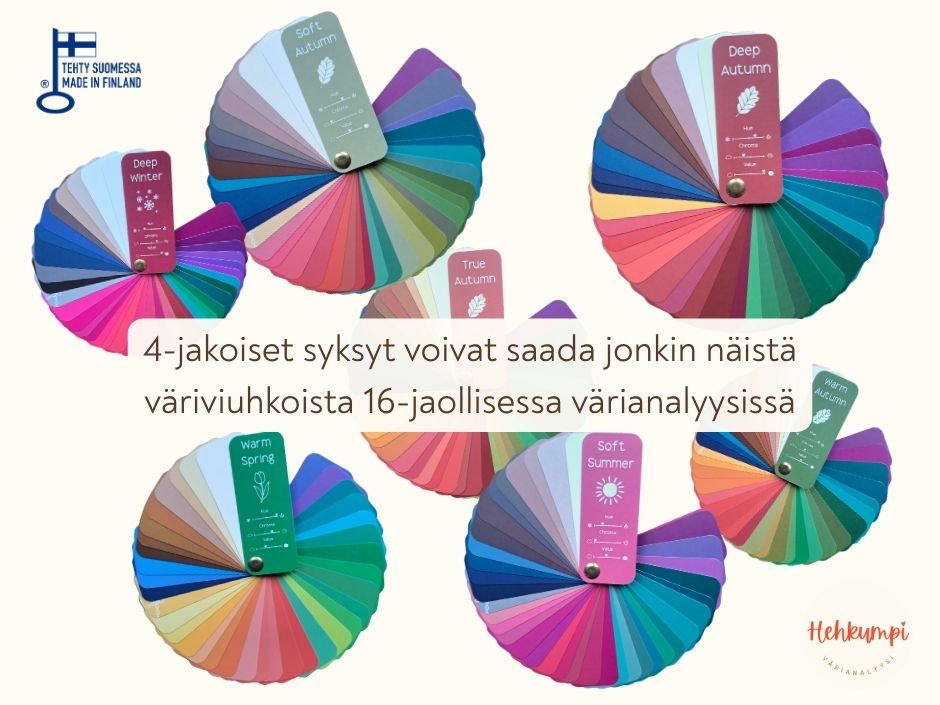
Next, I will go through the autumn color seasons of the 12- and 4-season color analyses and explain what the results can be in the 16-season color analysis. I will start with the 12-seasons color analysis autumn color seasons.
12-part warm autumn in 16-part color analysis
If you have obtained a warm autumn color season result in the 12-part color analysis, the 16-part color analysis result may be one of the following:
Warm autumn
Warm spring
True autumn
The result of a 16-part color analysis is most accurate when performed by a competent color consultant on color analysis fabrics and viewed in natural light. However, you can try to guess the 16-part color analysis result yourself using the following principles.

A warm autumn in 12 seasons remains a warm autumn in a 16 seasons color analysis
If you have obtained the result warm autumn in the 12-part color analysis, then in the 16-part it may well remain the same, i.e. warm autumn. If the lightest and brightest (spring colors) in the 12-part color analysis color palette have not felt the best and have not really been used, it may very well be possible that the result will remain nominally the same, i.e. warm autumn.

The warm autumn of the 16-part color analysis is, compared to the warm autumn of the 12-part, slightly more inclined towards autumn than towards spring in terms of color characteristics. The lightest and brightest shades of all have been omitted and replaced by shades more typical of autumn. However, the warm autumn of the 16-part is still the "brightest" of all the autumn subcategories and leans towards spring.

The warm autumn of 12-part turns into a warm spring of 16-part
The warm autumn of the 12-part color analysis may well change into a completely different color season in the 16-part color analysis, i.e., warm spring.

If the brightest and lightest colors in the 12-part warm autumn color palette have seemed better than the more autumnal tones, then the result may well be a warm spring in the 16-part.
The warm spring of the 16-part color analysis is more deep and even warmer than the 12-part and takes a small step closer to autumn compared to the warm spring of the 12-part.

A 12-part warm autumn is a real autumn in a 16-part color analysis
This is a very common change, meaning that it is often seen that a 12-part warm autumn is a true autumn in a 16-part color analysis. This is because a true autumn is the perfect color season for a customer who has actually been somewhere between the 12-part autumns.
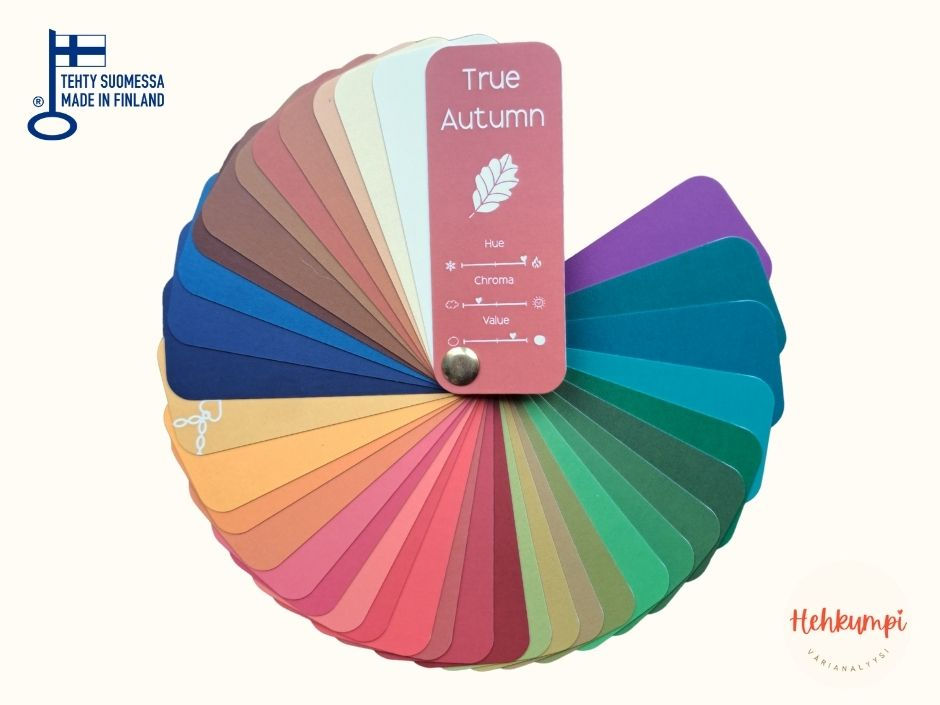
A true color season, and in this case, a true autumn, is uniform in its three color characteristics. A true autumn is uniformly warm, soft, and deep, meaning that none of these three characteristics dominates over the others. The prefix of a color season subcategory always determines what is the dominant characteristic of that color season.
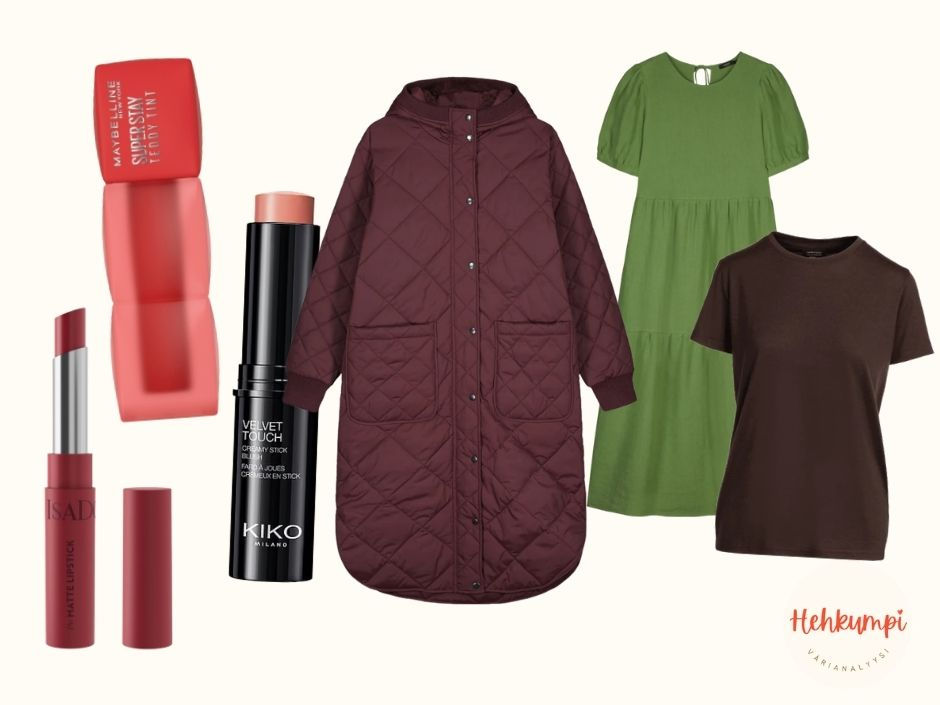
If you have achieved a warm autumn result in the 12-part palette and have been looking for more depth and softness in the colors of the palette, you are probably a true autumn in the 16-part color analysis. With the 12-part palettes, compromises have had to be made, but with the 16-part Hehkumpi color palettes, this "problem" has been eliminated.
12-part soft autumn in 16-part color analysis
If you have received a result of soft autumn in a 12-part, 16-part color analysis, the result may be one of the following:
Soft autumn
Soft summer
True autumn
Next, I will explain why a 12-part soft autumn can even change in temperature to the opposite in a 16-part color analysis.

A 12-part soft autumn remains a soft autumn in a 16-part color analysis
A 12-part soft autumn may well be a soft autumn in a 16-part color analysis as well. If the coolest colors in the 12-part color palette have not been used or otherwise felt good, then the result is very likely to be a soft autumn in a 16-part color analysis as well.

The 16-season Soft Autumn takes a small step towards the heart of autumn in terms of color characteristics and the colors in the color palette have been perfected for soft autumns. The most summery shades of all have been replaced with neutral shades that are excellent for soft autumn.

The soft autumn of the 12 seasons turns into a cool, i.e. soft summer in the 16 seasons
In some cases, a 12-part soft autumn may be a cool color season, i.e. soft summer, in a 16-part color analysis. This is not very likely, but it is still possible.
If the client's skin tone has been very close to neutral (but in reality still on the cool side) and the tolerance for darkness has been relatively high, then the 12-part result may have been determined as soft autumn and the soft autumn color palette may have been included. In such an exceptional case, it has been a more harmonious option.
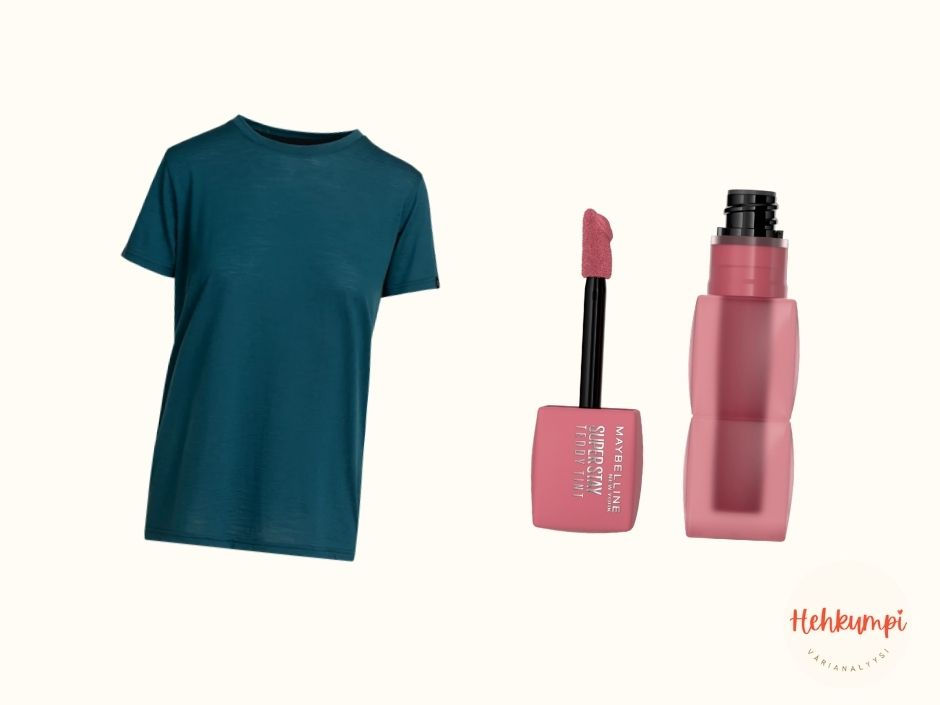
Soft Summer in 16 season color analysis is a much darker color season than Soft Summer in 12 seasons, and in a way, you could say that it is also on its way towards winter due to the darker tones (and towards autumn through the more neutral temperature and softness).
If you have got the result Soft Autumn, but you have been looking for more coolness from the colors in the color palette and the warmer tones have not been used, it may well be possible that the result is Soft Summer in the 16-part color analysis.

The soft autumn of the 12 season color analysis is the true autumn of the 16 season color analysis
A 12-part soft autumn can be a 16-part true autumn if the client is actually somewhere in between the 12-part autumn subcategories in terms of the result.
If you have achieved a soft autumn result in the 12-part, but have been looking for more warmth and depth in the colors of the color palette, you are very likely a true autumn in the 16-part color analysis.

12-part dark autumn in 16-part color analysis
If you have received a dark autumn result in the 12-part color analysis, the result in the 16-part color analysis may be one of the following:
Dark autumn
True autumn
Warm autumn

A deep autumn in 12-seasons color analysis remains a deep autumn in 16 seasons
If you have received a dark autumn result in a 12-part color analysis, but the colors in the color palette have seemed too warm, the result is probably also deep autumn in a 16-part color analysis.

The 16-degree dark autumn takes a step towards winter and its colors are slightly more neutral in temperature than the 12-degree dark autumn.

The dark autumn of the 12-part system is the true autumn of the 16-part system
If the result has been a 12-part dark autumn and the colors in the color palette have felt good, then the result is probably a 16-part true autumn. The 16-part true autumn corresponds quite a lot in terms of color properties to the dark autumn of the 12-part
This is a really common change, meaning that many 12-part dark autumns are indeed 16-parttrue autumns.
A 12-part dark autumn is a 16-part warm autumn
If you have received a dark autumn result in the 12-part palette, but you are in a warm autumn in the 16-part palette, this is entirely due to the limitations of the 12-part palette.
In the 12-part palette, warm autumn is completely between autumn and spring, when the colors are very light and bright. For some warm autumns in the 16-part palette, these have been too much in the 12-part palette, and a better and calmer color palette has been found overall in the dark autumn.
When we move from the 12-part palette to the 16-part Hehkumpi palette, warm autumn has taken a step closer to real autumn. In this case, the colors are no longer so strikingly bright and light, but more like fresh summer dress colors for autumn.
Autumn of 4-part color analysis in 16-part color analysis
If you have received the result autumn in the 4-part color analysis, then the result in the 16-part color analysis will most likely be one of the following:
True autumn
Warm autumn
Dark autumn
Soft autumn
Warm spring
Soft summer
Dark winter
This relatively wide range of different results is due to the fact that the 4-part color analysis method does not properly take into account the brightness-softness metric of color characteristics.
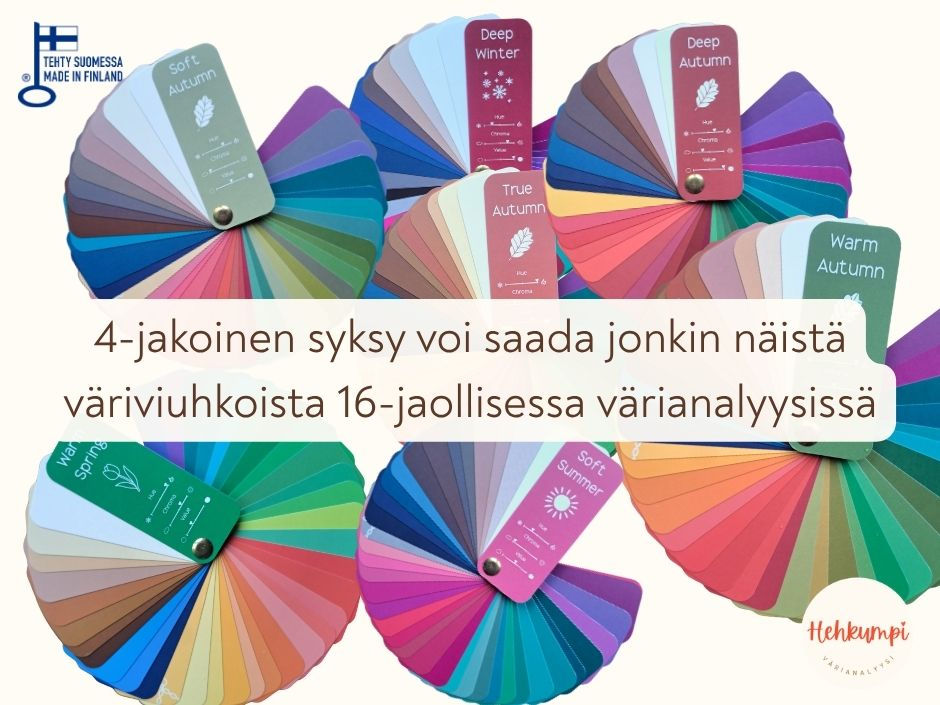
If the 4-part color scheme correctly identifies warmth and darkness, then the result is something like the 16-part color scheme autumn.
If warmth is identified, but brightness is not, then the result is probably warm spring. So if you were analyzed as autumn in the 4-part color scheme, but the colors seemed too intense, the result in the 16-part color scheme is probably a warm spring, closer to spring.
If the colors in the 4-part color scheme seemed too warm, then the common softness of autumn and summer has probably been blurred and you are a soft summer.
If darkness is identified, but you have been looking for more neutrality in the colors, the result of the 16-part color scheme may be a dark winter.

Why can the result of color analysis change quite radically when going from 4-part to 16-part color analysis?
When the result of a color analysis changes, for example, from a 4-part autumn and warm color season to a cool, soft summer, it can feel a little strange. How can warm become cool?
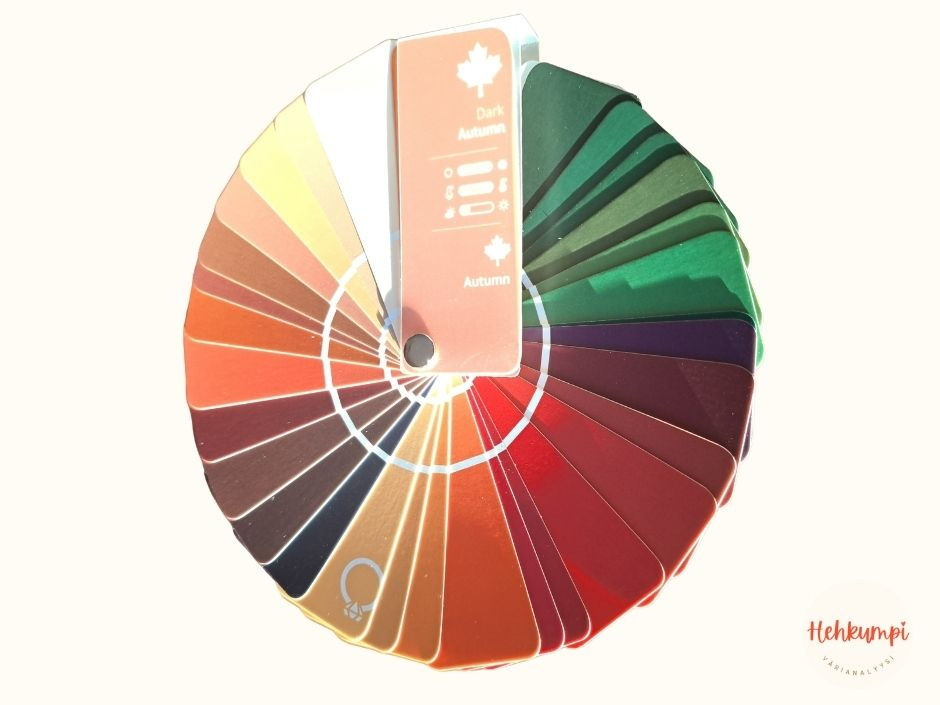
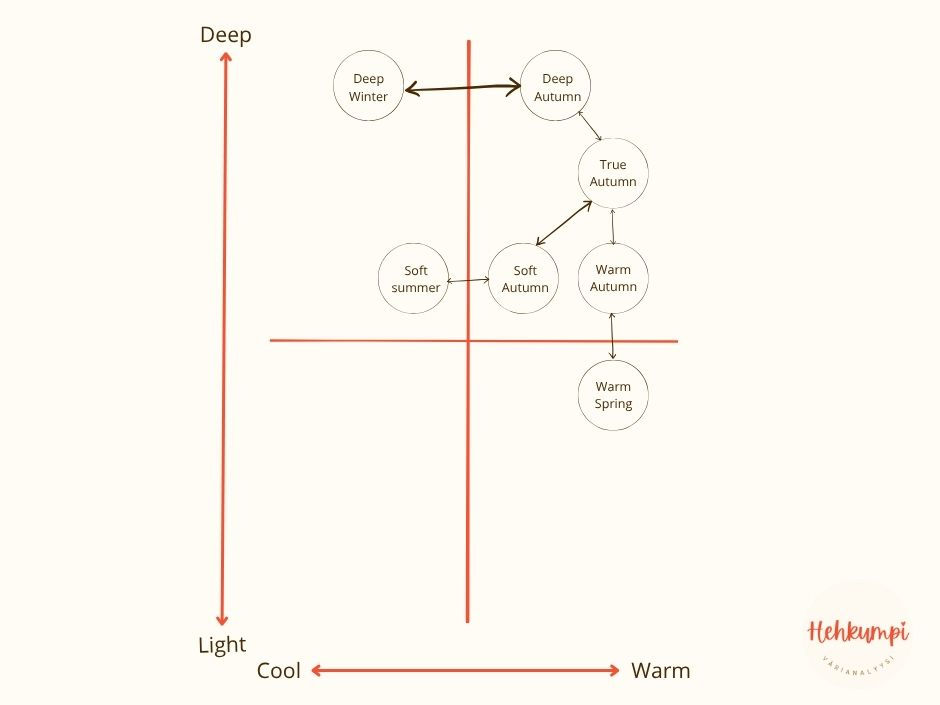
The reason for this is the harmony between the customer's characteristics and the color fans in use. When the soft summer of 16 parts has been given the result of autumn in 4 parts, the reason is visible in the following images.

Which of the 4-part color palettes, i.e. (dark) autumn or (light) summer, is more harmonious overall for the 16-part soft summer? The answer is autumn, but when the customer is assessed in a 16-part color analysis, the best colors are found in the soft summer.

The soft summer of the 16-part color analysis is closer to the 4-part autumn than to the summer in terms of the three color property metrics. Therefore, the 4-part autumn can turn into summer in the 16-part color analysis.
Even 16-part color analysis is not a direct answer to all questions
If we think about categorizing people into specific categories, then it is impossible to put all the people in the world into four or even sixteen categories. However, 16-part color analysis is in practice the most accurate and practical color analysis method that has been developed.
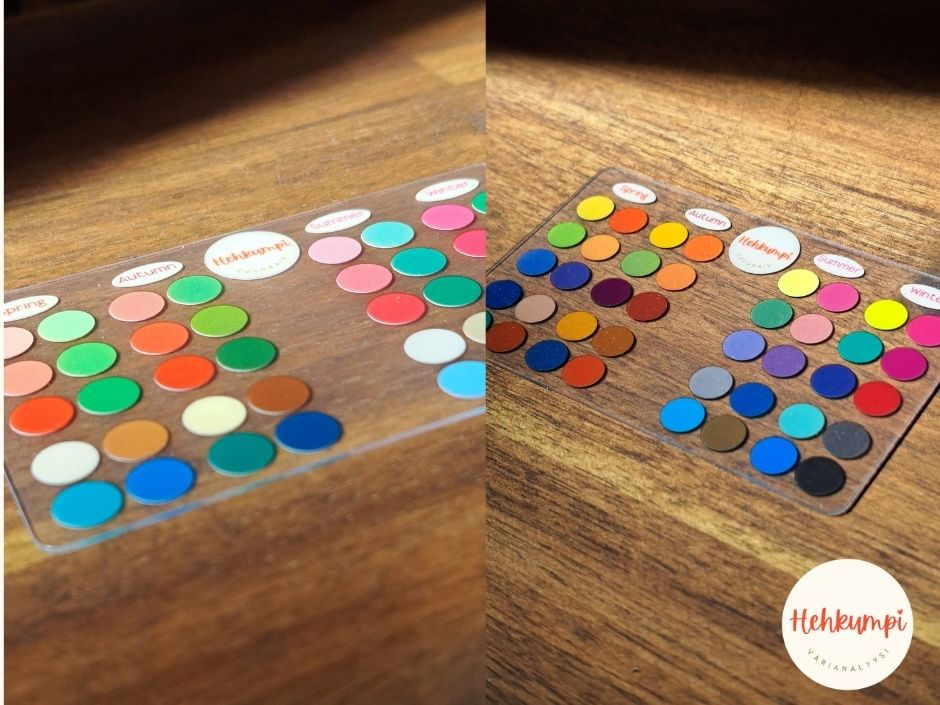
However, it is important to remember that when assessing the properties of colors, sometimes even a 16-part color analysis is not enough. Sometimes, for example, the temperature of the client's skin undertone may be completely neutral and it is practically impossible to put it even slightly on the cool or warm side.
In such situations, it is also good to be aware of the principles of the so-called 23-part color analysis and by utilizing them and the experience and professionalism of the color consultant, the best color palette is always found for the client and its use is tailored and guided individually according to the client's characteristics.
Thank you for reading my observations and thoughts on the relationship between autumn and different color analysis methods!
Did anything in this article surprise you? It would also be interesting to hear guesses that if you are an autumn, which autumn you could be in a 16-part color analysis?
If you have already had a color analysis (with me or elsewhere) and instead of guessing, you want complete certainty about your own best colors and the 16-part result, then book an appointment for a one-hour color consultation in Tuusula here!
And if you have not yet had a color analysis, then book an appointment for a comprehensive color analysis alone or with a group. A comprehensive color analysis always includes the domestic Hehkumpi color palette, which has been awarded the Key Flag label, and has been developed to serve the customer's individual color journey after the color analysis in the best possible way.


Comments